
When Hurricane Helene pushed inland across the Upstate in September 2024, Anderson County learned something a lot of inland facilities had assumed did not apply to them: you do not have to be on the coast to take serious water and wind damage. Between that storm, the severe thunderstorm season that runs from spring through late summer, and the tropical remnants that reach us most years, commercial facilities in Anderson, Oconee, Pickens, and Greenville counties see a lot of water.
Roads flood, trees come down, and power goes out. Those get attention. What often does not get attention is the mechanical equipment, which can absorb serious damage during a storm and then keep running for weeks while the real problem develops quietly.
A commercial system has three areas of exposure. Here is what water does to each.
Rooftop and outdoor equipment
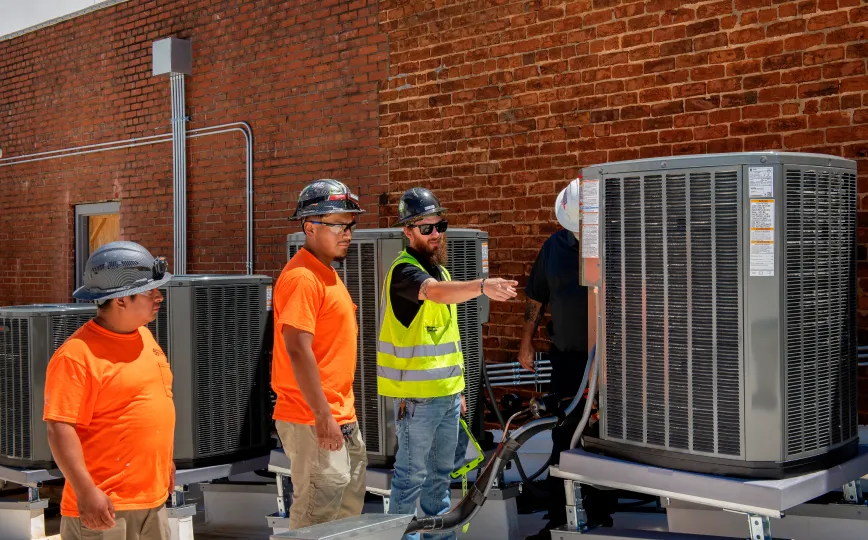
Packaged rooftop units, condensing units, condensers, and cooling towers are built to live outside. Electrical components are sealed, connections are insulated, and cabinets are made from materials that handle weather. But “built for rain” is not the same as “built for a storm.”
Roof drainage failure. This is the number one issue we find on commercial roofs after heavy rain. Blocked scuppers or internal drains let water pond around the equipment curb. A rooftop unit sitting in standing water will eventually take water in through the base, into the blower compartment and the control section. Check drainage before storm season, not after.
Curb and flashing leaks. Storm-driven rain moves sideways. Aging curb flashing that sheds a normal rain will let water past under wind load, and that water does not stay on the roof. It travels down through the curb into the ceiling plenum and the space below. The tenant complaint about a ceiling stain is often a mechanical curb problem.
Debris impact. Limbs, gravel, insulation, and loose roofing hit condenser coils during high wind. Bent or torn coil fins reduce heat transfer, which raises head pressure, which shortens compressor life. Damage that looks cosmetic from ten feet away is a measurable efficiency loss.
Shifted or unlevel equipment. Ground-mounted equipment on eroded pads can shift out of level. An unlevel condensing unit puts strain on refrigerant lines and interferes with proper oil return to the compressor. If a unit has visibly moved, shut it down until it is set back on firm, level footing.
Flooded ground-level equipment. Any outdoor unit that has been partially submerged should be de-energized and inspected before restart. Water reaches contactors, control boards, and motor windings, and a unit that appears to start normally can fail catastrophically weeks later.
One thing to avoid: do not tarp or wrap outdoor equipment. It traps moisture against the cabinet, accelerates corrosion, and creates a nesting site for pests. Running a unit while covered will damage the compressor.
Mechanical rooms and indoor equipment
Air handlers, boilers, chillers, pumps, and control panels are built for a dry, conditioned environment. They have essentially no tolerance for standing water.
Mechanical rooms in Anderson-area facilities are frequently in basements, on ground level in older mill and industrial buildings, or in interior spaces under a roof that may be leaking. Any of those can take on water during heavy rain.
If a mechanical room floods:
- Kill power at the main disconnect, not at the thermostat or control panel. Do not enter standing water in an energized mechanical room.
- Do not attempt to restart equipment to see if it works. Energizing a wet motor or control board is how a repairable problem becomes a replacement.
- Document conditions with photographs and water line measurements before cleanup begins. Your insurer will want it.
- Get a professional inspection. Motors, VFDs, control boards, contactors, and gas valves that have been submerged need to be evaluated individually. Some are salvageable after proper drying, many are not.
Gas-fired equipment deserves particular caution. A submerged gas valve or control on a boiler or furnace should be replaced rather than dried out and returned to service. This is a safety issue, not a cost issue.
Ductwork and building envelope
This is the damage that shows up months later, and it is the most expensive to resolve.
Commercial ductwork is not waterproof. When a roof leak, a curb leak, or a flooded crawlspace introduces water into a duct system, that water does not simply evaporate. It sits in low points of the duct run, saturates internal liner and external wrap insulation, and creates conditions for microbial growth in a system that then distributes air throughout your building.
The consequences compound:
- Wet insulation stops insulating. Saturated duct wrap loses most of its R-value, so the system runs longer cycles to hold setpoint and your energy costs climb without an obvious cause.
- Corrosion begins. Persistent moisture attacks seams, fasteners, and hanger assemblies, and duct integrity degrades over time.
- Air quality suffers. Mold and bacterial growth inside the duct system becomes an occupant health matter, and in a school, medical facility, restaurant, or food production plant it becomes a regulatory matter.
- The source often goes unnoticed. A slow roof leak above a ceiling plenum can run for a full season before anyone sees evidence at floor level.
If your building has a musty odor after a wet season, or if occupant complaints spike without a corresponding equipment fault, the duct system is the place to look.
A post-storm checklist for facility managers
Work through this after any significant rain or wind event:
- Walk the roof. Check drains, scuppers, curb flashing, and any displaced equipment panels.
- Inspect condenser and cooling tower coils for debris and fin damage.
- Check that outdoor equipment is level and secure on its pad or curb.
- Open and inspect mechanical rooms for water intrusion, including under equipment skids.
- Look at ceiling tiles and wall surfaces below rooftop equipment for staining.
- Verify condensate drains and pans are clear and draining, since blocked drains cause their own flooding indoors.
- Note any change in system sound, cycling behavior, or capacity.
- Log everything, with dates and photographs.
If any of it looks questionable, shut the equipment down rather than running it and hoping.
We are available when the weather is not
MCG Mechanical provides service 24 hours a day, 7 days a week to commercial and industrial facilities across upstate South Carolina, western North Carolina, and northeast Georgia. We service everything from single-tenant commercial buildings to industrial plants and hospitals, and after a major weather event we can evaluate whether your system is safe to operate or needs repair before restart.
The better investment is prevention. A planned maintenance agreement gets your roof drainage, curb condition, coils, and mechanical rooms inspected on a schedule, before storm season instead of after it.
Get in touch with our team today!