
Unbiased guidance for facility managers, plant engineers, and business owners in the Upstate
Since 2009, MCG Mechanical has designed, fabricated, installed, and serviced more than 30,000 tons of air conditioning across upstate South Carolina, western North Carolina, and northeast Georgia. Schools, hospitals, manufacturing plants, churches, restaurants, and municipal buildings. In that time we have opened up just about every major brand of commercial equipment on the market, and we have watched which ones hold up in a Carolina summer and which ones do not.
So when a facility manager in Anderson asks us which brand is best, our answer tends to surprise them: the label on the cabinet is one of the least important decisions you will make.
Here is what actually determines whether your system performs.
The part the brochures leave out
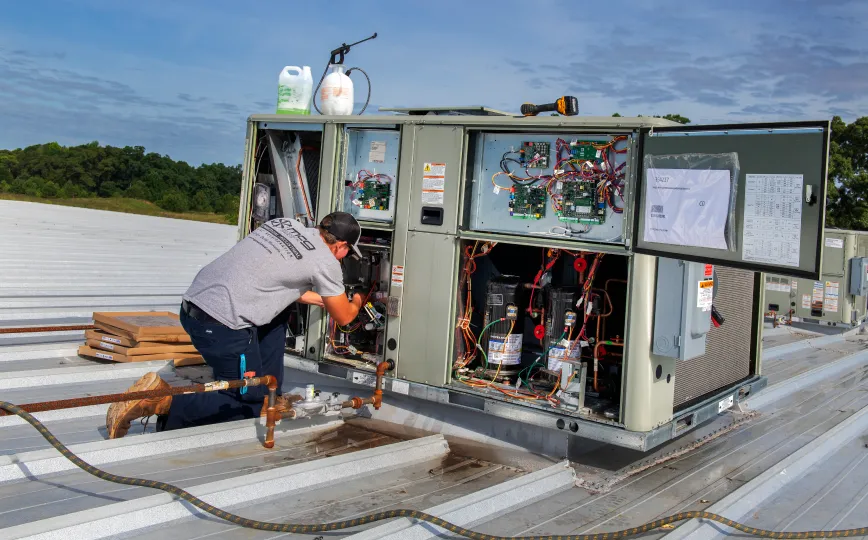
Pull the panel off a rooftop unit and the internal components look remarkably similar from one brand to the next. A handful of major manufacturers produce the large majority of equipment sold in the United States, under a much longer list of brand names. Several of those names share factories, share component suppliers, and in some cases share nearly identical engineering.
A few of the relationships worth knowing:
- Trane and American Standard are both under Trane Technologies and are largely the same equipment with different badging.
- Carrier, Bryant, and Payne sit under the Carrier umbrella, with pricing and brand recognition varying more than the hardware does.
- York, Luxaire, and Coleman all fall under Johnson Controls.
- Goodman, Amana, and Daikin are part of the same corporate family, with Daikin bringing its own inverter and VRV engineering to the group.
- Lennox, Ducane, and Concord all come from Lennox.
None of this means brands are interchangeable in every application. Mitsubishi Electric and Daikin, for example, have a genuine engineering lead in variable refrigerant flow, which is why we specify VRF from those lines on renovations of older Anderson-area buildings where running conventional ductwork would be invasive or impossible. Chiller and boiler selections for larger plants involve real performance differences at part load. But for the bread-and-butter packaged rooftop units, split systems, and air handlers that condition most commercial square footage in Anderson County, the differences between reputable brands are smaller than the marketing suggests.
What actually drives performance: design and installation
Commercial HVAC is not a product you buy off a shelf. It is a system that gets engineered into a specific building.
Two identical 20-ton rooftop units installed on two identical buildings will perform very differently if one has undersized return air paths, poorly sealed duct joints, or a curb adapter that never should have been used. We see this constantly on renovation and retrofit work in the Upstate, where a new unit gets set on a curb designed for equipment from three decades ago and the airflow never has a chance.
The variables that matter most:
- Load calculation. Anderson sits in a hot, humid climate zone with summer design conditions in the low-to-mid 90s and design wet bulb temperatures high enough that latent load (moisture removal) is a serious part of the equation. Oversized equipment short-cycles, never runs long enough to dehumidify, and leaves you with a building that feels clammy at 72 degrees. Undersized equipment runs continuously in July and dies early. Neither problem has anything to do with the brand.
- Ductwork and air distribution. This is why MCG operates a 20,000 square foot sheet metal shop at our Anderson location. We fabricate our own duct, transitions, equipment stands, hangers, grease duct, and exhaust hoods, which means the distribution system is built for your building rather than assembled from whatever fittings were on the truck.
- Startup and commissioning. Refrigerant charge, airflow verification, control sequence testing, and economizer setup are where a system either meets its rated efficiency or quietly loses fifteen percent of it on day one.
- Ongoing maintenance. A well-maintained mid-tier unit will outlast a neglected premium unit every time.
Choosing the contractor: what to watch for
Since the contractor matters more than the brand, evaluate the contractor with the same rigor you would apply to a capital purchase.
Red flags:
- A quote without a site visit. Anyone willing to price a commercial replacement over the phone has not looked at your curb, your electrical service, your structural capacity, or your existing duct. That number will change.
- Single-line dealers presenting one option as the only option. If a contractor can only sell you one manufacturer, you are not getting a recommendation, you are getting inventory.
- Discounted or discontinued equipment. A deep discount on a superseded model can mean limited parts availability three years from now, which turns a routine repair into a week of downtime.
- No in-house sheet metal or fabrication capability. Subcontracted duct work adds a coordination layer and a schedule risk on any project with a tight timeline.
- Thin service commitment. Equipment fails on the hottest Friday in August. Ask directly what after-hours response looks like and who answers the phone.
What to require:
- Licensed, trained, full-time technicians rather than transient labor.
- A written scope covering ductwork, controls, electrical, and commissioning, not just the equipment model number.
- References from facilities comparable to yours. If you run a manufacturing plant, ask for plant work. If you manage a medical facility, ask for medical work.
- A clear preventative maintenance proposal with defined tasks and intervals.
Comparing equipment fairly
When you do get to the equipment comparison, make sure you are comparing like for like:
- Efficiency ratings. Confirm you are looking at the same metric across bids. Commercial equipment is now rated in IEER and SEER2 depending on category, and mixing metrics across proposals makes a lower bid look better than it is.
- Parts availability. Proprietary components can extend lead times significantly. For a facility that cannot tolerate downtime, availability may be worth more than a modest efficiency gain.
- Warranty terms. Compare compressor, heat exchanger, and parts coverage separately, and note what labor is included and for how long.
- Controls. Whether the unit integrates cleanly with your existing building automation system is often the deciding factor on a campus or multi-building site.
- Total cost of ownership. Utility rates, run hours, and expected service intervals over a fifteen to twenty year life will dwarf the difference in purchase price between two comparable units.
Bottom line
The best commercial HVAC brand is the one that is correctly sized for your load, properly installed with distribution built for your building, commissioned to spec, and maintained on a real schedule.
MCG works with all major manufacturers, including Trane, Carrier, Daikin, and Mitsubishi Electric. We are not a single-line dealer, and we have no incentive to steer you toward a particular badge. Our focus is on solutions, specifications, and service, in that order.
If you are planning an equipment replacement, a plant expansion, or a new build in Anderson, Greenville, Seneca, Clemson, or anywhere across the Upstate, we will evaluate your facility and give you a straight recommendation.
Get in touch with our team today!