
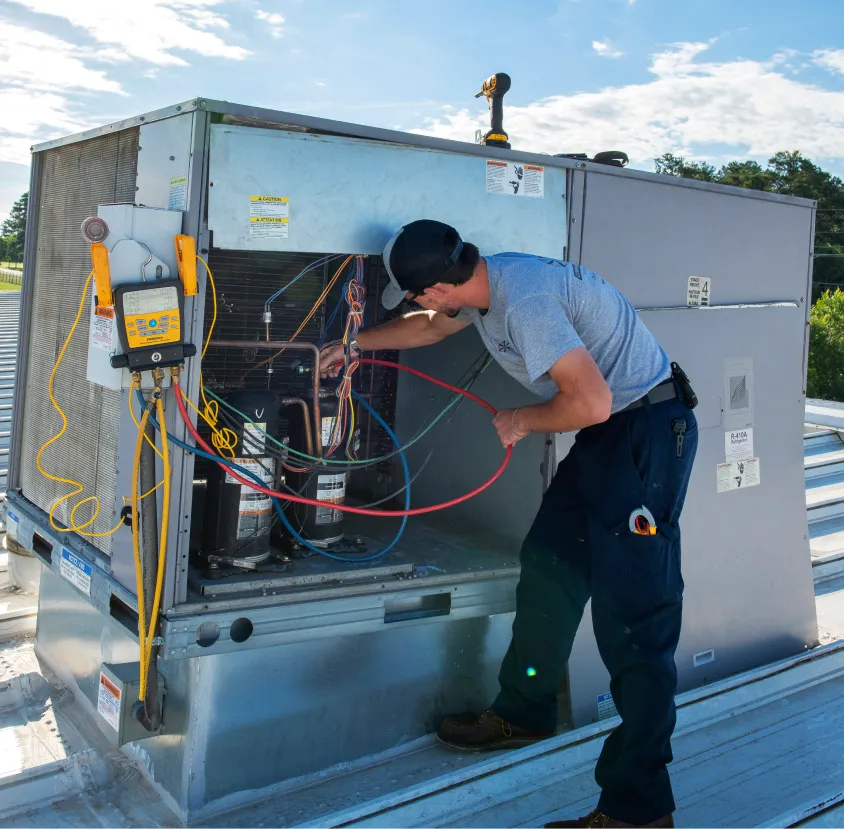
If you have ever reviewed a mechanical proposal and seen a rooftop unit described as “20 tons,” you may have wondered what a unit that weighs roughly a ton and a half is doing being called twenty of them.
It is a fair question, and the answer goes back to how buildings were cooled before mechanical refrigeration existed. It is also more than trivia. Understanding what tonnage actually measures is the first step toward understanding why correct sizing matters so much, and why bigger is not better.
Start with the BTU
A BTU, or British Thermal Unit, is a unit of heat energy. One BTU is the amount of heat needed to raise the temperature of one pound of water by one degree Fahrenheit. For scale, a single kitchen match releases roughly one BTU.
HVAC equipment is rated in BTUs per hour, which is a rate rather than a quantity. A system rated at 60,000 BTU/h can remove 60,000 BTUs of heat from a space every hour it runs.
That framing matters. An air conditioner does not create cold. There is no such thing as cold, only the absence of heat. What the equipment actually does is move heat from inside your building to outside it, using refrigerant as the transport medium. Rating equipment in BTUs per hour describes how fast it can move that heat.
Now the ice
Before mechanical refrigeration, commercial cooling meant ice. Ice was harvested from northern lakes in winter, stored in insulated icehouses, and shipped south by rail and wagon. Buildings, rail cars, and cold storage rooms were cooled by melting large blocks of it.
Here is the physics that gave us the ton:
Melting ice absorbs heat without changing temperature. This is latent heat, specifically the latent heat of fusion, which for water is approximately 144 BTU per pound. So melting one ton of ice, 2,000 pounds, absorbs about 288,000 BTUs.
Spread that across a full day:
288,000 BTUs ÷ 24 hours = 12,000 BTUs per hour
That is a ton of refrigeration. One ton of cooling capacity equals 12,000 BTU/h, which is exactly the cooling effect you would get from one ton of ice melting steadily over 24 hours.
When mechanical refrigeration arrived, manufacturers needed a way to explain capacity to customers who had only ever bought ice. Telling a cold storage operator that a machine did the work of ten tons of ice a day was immediately meaningful. The terminology stuck, and more than a century later it is still the standard unit in North American commercial HVAC.
Doing the math
The conversion is simple:
- Tons to BTU/h: multiply by 12,000. A 20-ton rooftop unit is rated at 240,000 BTU/h.
- BTU/h to tons: divide by 12,000. A 90,000 BTU/h system is 7.5 tons.
Common commercial sizes and their ratings:
| Tons | BTU/h | Typical application |
| 3 | 36,000 | Small office suite, retail bay |
| 5 | 60,000 | Restaurant zone, small commercial space |
| 10 | 120,000 | Mid-size retail, office floor |
| 20 | 240,000 | Large retail, school wing, light industrial |
| 50 | 600,000 | Large facility, typically multiple units or a chiller |
| 500+ | 6,000,000+ | Chiller plant serving a hospital, campus, or manufacturing facility |
For context, when MCG notes that we have designed and installed more than 30,000 tons of air conditioning since 2009, that is 360 million BTUs per hour of cooling capacity across Upstate South Carolina, western North Carolina, and northeast Georgia.
What tonnage does not tell you
Here is where a lot of purchasing decisions go wrong. Tonnage is a single number describing total capacity, and a commercial cooling load is not a single number.
Sensible versus latent load. Sensible cooling lowers air temperature. Latent cooling removes moisture. In Anderson and across the Upstate, summer design wet bulb temperatures are high enough that latent load is a substantial share of the total. A unit selected purely on total tonnage, without attention to its sensible heat ratio, can hold your setpoint temperature while leaving the building humid and uncomfortable. Occupants will report that it feels warm even though the thermostat reads 72.
Airflow. Capacity is only delivered if air moves. The rule of thumb is roughly 400 CFM per ton, and a system starved by undersized duct, dirty coils, or restricted returns will not deliver its rated capacity regardless of what the nameplate says. This is a large part of why we fabricate duct in our own shop rather than treating distribution as an afterthought.
Load distribution across zones. A building’s total load may be 40 tons, but if the west-facing conference room, the server closet, and the kitchen all peak at different times, one 40-ton unit will serve none of them well.
Why oversizing is a real problem
Buyers often assume extra capacity is cheap insurance. In practice, oversized equipment causes measurable problems:
- Short cycling. An oversized unit satisfies the thermostat quickly and shuts off. Because moisture removal happens gradually across a longer run cycle, short cycles leave humidity in the building.
- Component wear. Compressor starts are the hardest thing a compressor does. More cycles per day means shorter equipment life.
- Reduced efficiency. Equipment reaches rated efficiency at steady state. Constant starting and stopping never gets there.
- Higher first cost. You pay for capacity, electrical service, and structural support you do not need.
Undersizing brings its own consequences, of course: continuous runtime through July and August, inability to hold setpoint on design days, and premature failure. The goal is not conservative or aggressive sizing. It is accurate sizing.
Accurate sizing means a real load calculation
A proper commercial load calculation accounts for building orientation and envelope, glazing area and type, insulation values, occupancy and schedule, lighting and equipment heat gain, process loads in industrial spaces, ventilation requirements, infiltration, and local design conditions.
Anderson’s climate makes that last item important. Our summer design conditions and high humidity mean a system sized by square-foot rule of thumb, or by matching whatever was there before, is frequently wrong. Buildings change. Lighting gets retrofitted to LED, occupancy shifts, process equipment gets added or removed, and the load that justified the old unit may no longer exist.
Talk to us before you size the next one
MCG Mechanical performs complete design and analysis, duct and piping fabrication, installation, startup, and commissioning for commercial and industrial facilities across the Upstate. We work on everything from conventional packaged equipment to chiller and boiler plants serving manufacturing facilities, schools, and hospitals.
If you are planning a replacement, an expansion, or a new build, we will run the numbers rather than guess at them.
Get in touch with our team today!